
WhatsApp Chatbots for Business: Automate Sales & Support Without Losing the Human Touch
WhatsApp Chatbots for Business: Automate Sales & Support Without Losing the Human Touch
It's 11:30 pm. Someone's messaged your business on WhatsApp; they want pricing, a product recommendation, and ideally a consultation booked before they lose interest. Your team's asleep, or at dinner, or just not checking messages at that hour, because nobody reasonably should be.
By the time anyone gets to that message the next morning, there's a decent chance the customer has already messaged a competitor, gotten an answer, and moved on. This isn't a rare scenario. It happens constantly to businesses of every size, and it's one of the more frustrating ways to lose a sale, not because the offer wasn't good enough, but because nobody was there when the question was asked.
Hiring a support team to cover every hour of every day isn't realistic for most businesses. This is exactly the gap a WhatsApp chatbot is built to close, and the good ones don't just fire off scripted replies. Modern AI-powered assistants can understand what someone's actually asking, answer helpfully, qualify a lead, book an appointment, and, just as importantly, know when to step aside and bring in an actual human.
Why WhatsApp Specifically
For a huge number of people, WhatsApp isn't a backup channel; it's the default way they communicate, full stop. Filling out a contact form and waiting for an email reply feels slow and a little old-fashioned by comparison. Sending a message and expecting a fast response is just how people expect to interact with businesses now.
That expectation cuts both ways. Businesses that respond quickly on WhatsApp tend to see more qualified leads, faster support resolution, stronger engagement, and better customer satisfaction overall. The channel isn't the hard part; getting messages on WhatsApp is easy. The hard part is responding to all of them, consistently at whatever hour they arrive.
What a WhatsApp Chatbot Actually Does
The easiest way to think about it is as a team member who never clocks out, one whose entire job is handling the repetitive parts of a conversation so your actual staff can focus on the parts that need a real person.
The important distinction is between older, rigid chatbots and what's available now. The keyword-matching, decision-tree bots that ask "type 1 for sales, type 2 for support" are still around, but they're not what's driving results anymore. Modern AI-powered assistants understand natural language, they interpret what someone actually means, not just which exact phrase they typed, which makes the whole conversation feel considerably less robotic.
Where Businesses Are Actually Using This
Every business has a handful of conversations that repeat constantly. Those are almost always the right place to start.
Capturing and qualifying leads
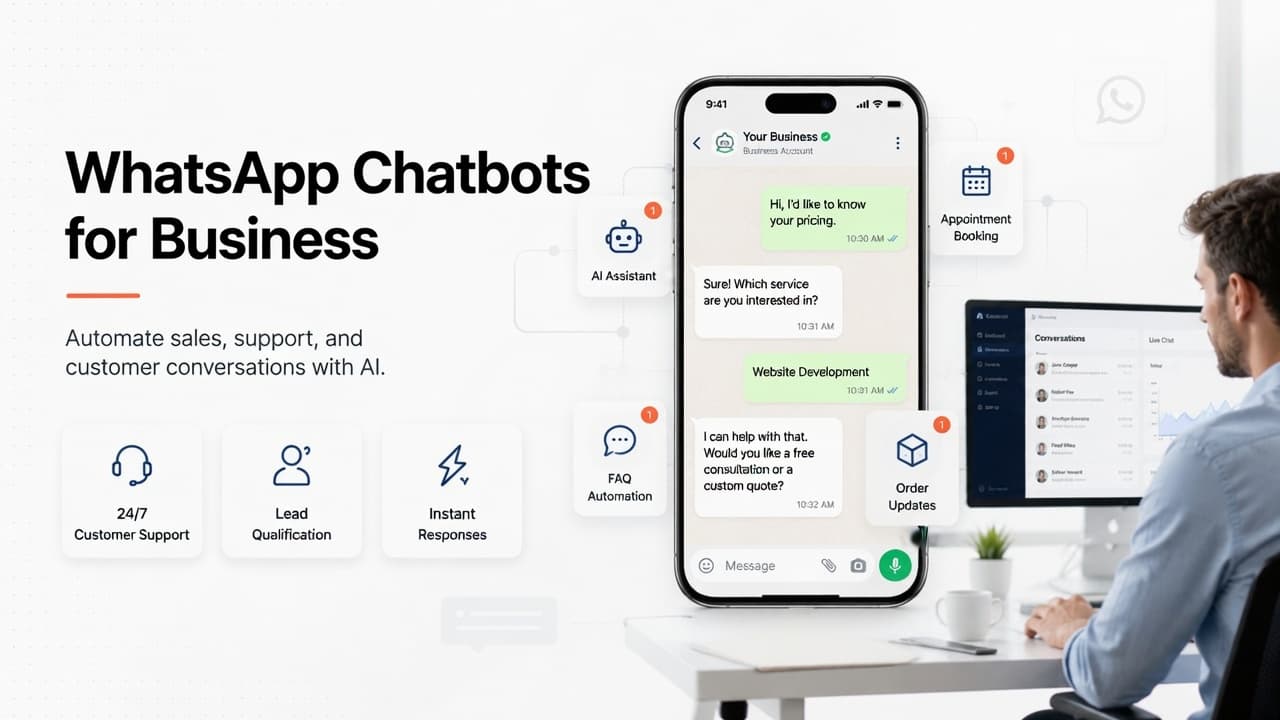
Instead of a generic "leave a message, and we'll get back to you," an AI chatbot can actually run the qualifying conversation, what service someone's interested in, roughly what size their company is, what budget range they're working with, and when they'd want to get started. By the time a real salesperson joins the thread, they're not starting from zero. They already know enough to move the conversation forward instead of re-asking questions the customer already answered.
Answering the questions that come up constantly
Pricing, business hours, delivery timelines, refund policy, what services are actually offered, and most support inboxes are dominated by a fairly small set of repeated questions. A chatbot can answer these instantly, at any hour, which takes a real chunk of load off a support team without making customers wait for something simple.
Booking appointments without the back-and-forth
For businesses running on consultations, demos, or scheduled appointments, a chatbot can check actual availability, suggest realistic time slots, confirm the booking, send reminders, and handle rescheduling, all without a human touching a calendar. Customers get a smooth, immediate booking experience instead of a multi-message negotiation over what time works.
Sharing order updates automatically
"Where's my order?" is one of the most common messages any ecommerce or service business receives, and it's almost always answerable without a human looking anything up manually. A chatbot connected to order data can pull the real-time status and respond instantly, which means fewer repetitive tickets landing on your support team's desk.
Making the Chatbot Actually Know Your Business
One of the more meaningful advances in this space is the ability to build a chatbot that understands your specific business, not just generic conversational patterns. This is typically done through something called Retrieval-Augmented Generation, or RAG for short.
Instead of generating an answer from scratch and hoping it's accurate, the chatbot searches your actual trusted sources, your website, product documentation, FAQs, internal knowledge base, policies, help articles, and builds its response from that real information. The practical upshot is more accurate, more relevant answers, and a chatbot that gets smarter as your documentation grows, without anyone having to manually rewrite every possible response by hand.
How This Actually Connects to WhatsApp
Getting a chatbot live on WhatsApp usually comes down to two pieces working together.
The WhatsApp Business Platform provides the official infrastructure for sending and receiving messages at scale, built for businesses that need automation, integrations, and multiple people or systems handling conversations at once, rather than one phone with the regular WhatsApp app installed.
The AI layer is what actually handles the conversation, and it can connect to more than just a knowledge base, CRM platforms, booking systems, inventory databases, payment gateways, support tools, and internal APIs. That's the difference between a chatbot that can only answer questions and one that can actually perform real tasks, like checking real stock levels or pulling an actual order status instead of guessing.
Mistakes That Undercut the Whole Thing
Trying to automate every single conversation. Some conversations genuinely need empathy, judgment, or a level of nuance a chatbot shouldn't be making decisions about: a frustrated customer, a complex complaint, anything emotionally loaded. A well-built chatbot should recognize this and hand off to a human, not push through on its own. Good automation supports your team. It's not meant to replace judgment entirely.
Leaving responses generic. Customers notice fast when a bot's answers feel like they came from nowhere in particular, vague, templated, not quite matching how the business actually talks or what it actually offers. Training the chatbot on real content, real products, and real policies is what makes the difference between "helpful" and "obviously automated."
Never looking at the conversation data. Every interaction a chatbot has is genuinely useful feedback, including which questions come up constantly, where people drop off mid-conversation, how often it escalates to a human, and how accurate its answers actually are. Businesses that check this regularly tend to keep improving the chatbot. Businesses that set it up once and never revisit it tend to watch it quietly get worse over time.
What This Actually Returns
A well-built WhatsApp chatbot tends to show up in a few measurable places: faster response times across the board, more qualified leads reaching sales, lower support costs, higher customer satisfaction, more appointments actually getting booked, and a sales process that moves more efficiently because reps aren't starting every conversation from scratch.
None of that requires replacing the team. It requires handling the repetitive layer consistently, so the people on your team spend their time building relationships and solving the problems that actually need a person, which, most of the time, is a better use of everyone's day anyway.
Is This Actually a Fit for Your Business?
A reasonable gut-check: if your team regularly fields messages like "how much does this cost," "do you have this in stock," "can I book a time," "where's my order," or "what do you actually offer,"; multiple times a day, every day, there's a strong chance automation would make an immediate, noticeable difference. If your team is spending real hours answering the same five questions on repeat, that's exactly the kind of workload a chatbot is built to absorb.
Frequently Asked Questions
Will a WhatsApp chatbot feel robotic to customers? It shouldn't, if it's built properly. Modern AI chatbots trained on your actual business content and using natural language understanding tend to feel conversational rather than scripted. The chatbots that feel robotic are usually older, keyword-based systems or ones trained on generic content instead of the business's own information.
Do I need the official WhatsApp Business Platform to run a chatbot? For most businesses beyond a very small scale, yes, it provides the infrastructure needed for automation, multiple agents, and integrations that the regular WhatsApp Business app doesn't support.
Can a WhatsApp chatbot replace my customer support team? Not entirely, and it shouldn't try to. The goal is to remove repetitive, low-complexity conversations so your team can focus on the interactions that genuinely need human judgment, not eliminating the human side of support.
How long does it take to set up a WhatsApp chatbot for a business? It depends on complexity; a chatbot answering FAQs and qualifying leads can often launch in a few weeks, while one deeply integrated with CRM, booking, and inventory systems takes longer to build and test properly.
Final Thoughts
Customer expectations have genuinely shifted. People want fast, convenient answers, often outside anything resembling normal business hours, and increasingly they expect to get that through a simple message rather than a form or a phone call. A well-built WhatsApp chatbot lets a business meet that expectation without needing to staff support around the clock.
Whether it's qualifying leads, answering the same questions on repeat, booking appointments, or sharing order updates, AI-powered chatbots create a faster, more consistent experience, while keeping real people available exactly where they're actually needed. The goal was never to remove the human touch. It's to make sure it shows up at the moments that actually call for it.
Ready to Build a WhatsApp Chatbot for Your Business?
Whether you need a WhatsApp assistant, a chatbot for your website, or an AI agent connected directly to your business systems, we design and build custom AI solutions around how your business actually works, not a generic script.
Let's talk about what your team spends the most time repeating, and build a chatbot that takes it off their plate.
More posts
All posts →
Top 10 AI Automation Workflows Every Small Business Should Implement in 2026
You don't need a dev team or a six-figure budget to put AI to work in your business. Here are the 10 automation workflows small businesses are actually using right now to save hours every week, plus the mistakes that quietly waste all the time savings.

Why Your Website Gets Traffic but No Leads (And How to Actually Fix It)
Thousands of visitors a month and an inbox that stays quiet, it's one of the most confusing problems in business, because everything on paper says the marketing is working. It's not a traffic problem. Here's what's actually going on and how to fix it.