How to Launch a SaaS MVP Fast Without Overbuilding It
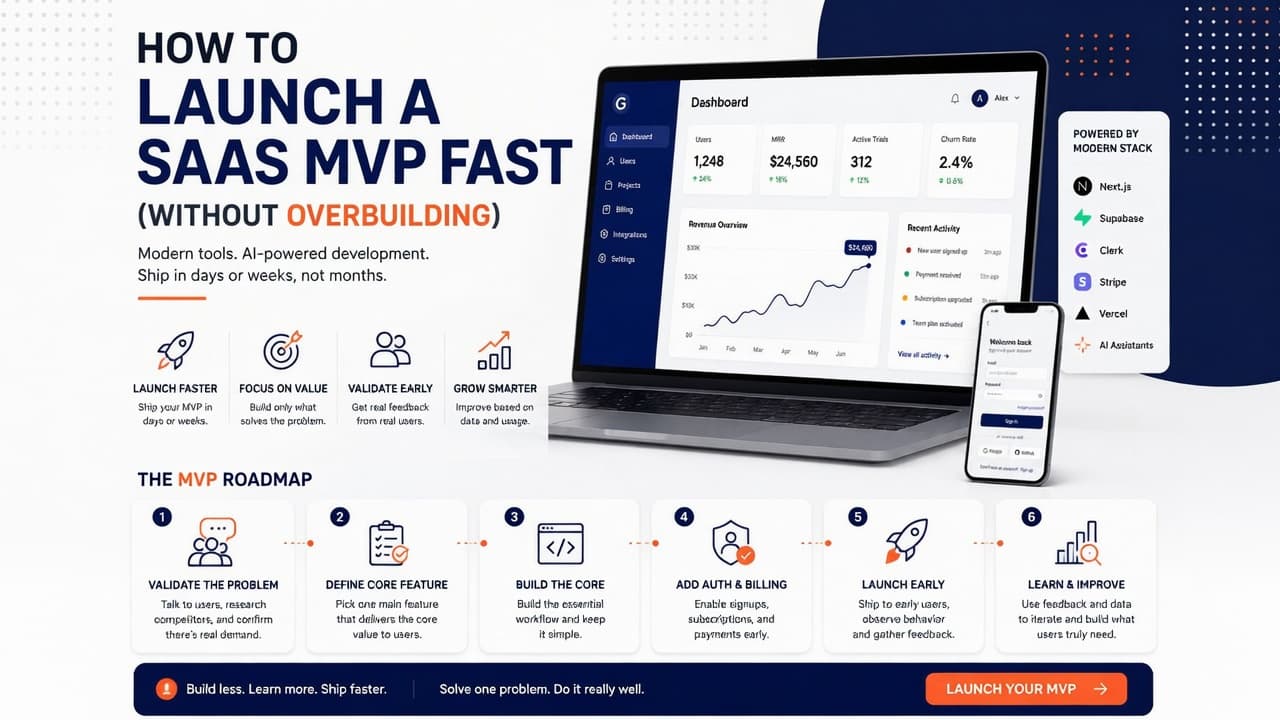
How to Launch a SaaS MVP Fast Without Overbuilding It
A few years back, shipping a SaaS MVP in three months counted as moving quickly. Today, with AI writing a good chunk of the boilerplate and a mature stack of tools like Next.js, Supabase, Clerk, and Stripe doing the heavy lifting, founders are getting usable products in front of users in weeks. Sometimes days.
That sounds like great news, and mostly it is. But there's a catch nobody talks about enough: AI can write code fast. It has no idea what you shouldn't build. And that gap is exactly why so many founders still burn two months polishing a dashboard nobody asked for, while the actual question is, does anyone want this? sits unanswered.
The startups that move fastest right now aren't the ones cranking out the most code. They're the ones who figured out early what to leave out.
The Point of an MVP Hasn't Changed, Even If the Tools Have
It's easy to assume that because building is faster now, the definition of "MVP" has changed too. It hasn't.
An MVP was never meant to be a stripped-down version of your full product. It's the smallest thing you can put in front of real users that answers one question honestly: is this solving a problem people actually have, and will they pay to have it solved?
If the answer's yes, you build on it. If it's no, you've just saved yourself months of work on something nobody wanted in the first place. That's the whole job of an MVP, and it hasn't changed since long before AI coding assistants existed.
Why MVPs Ship So Much Faster Now
The honest answer is that almost nobody builds from scratch anymore. A modern SaaS stack typically looks something like:
Next.js for the frontend
Supabase or Firebase for the backend
Clerk or Auth.js for authentication
Stripe for subscriptions and billing
Vercel for deployment
AI coding assistants for the repetitive parts of development
Instead of spending weeks building a login system, a payments flow, and an admin panel from zero, teams are wiring together tools that already work and putting their actual effort into the product itself. That shift, from building infrastructure to assembling it, is the real reason MVPs that used to take a quarter now take a few weeks.
A Roadmap That Actually Fits How Fast Things Move Now
Thinking in months doesn't really make sense anymore. It's more useful to think in milestones.
Step 1: Validate the problem before you write a line of code
This step gets skipped more than any other, usually because writing code feels more productive than having conversations. Talk to the people who'd actually use this. Read the one-star reviews of your closest competitors; they're often more useful than the five-star ones. Find out what people are already paying money to solve, even badly.
If nobody's bothered by the problem you're solving, shipping faster just means finding that out sooner. Which, to be fair, is still useful. It's just not the win it feels like.
Step 2: Pick one core feature and mean it
Every SaaS product that's gone on to matter started by doing one thing well. Ask yourself plainly: if a user could only do one single thing inside this product, what would it be?
Everything else is secondary until that one thing works. If your MVP plan has ten "essential" features before it's usable, the scope is too big, not the timeline.
Step 3: Build only the core workflow
Most MVPs genuinely only need:
User registration
A basic dashboard
The core feature itself
Simple settings
A database
A minimal admin panel
That's it. No advanced customization, no enterprise features, no "while we're at it" additions. The only job here is getting a user from signup to their first real success as fast as possible.
Step 4: Don't postpone payments
This is where a lot of founders talk themselves into a delay. "We'll add billing once we know people like it" sounds reasonable, but it quietly avoids the real test. If your product is meant to make money, your MVP needs to test whether people will actually pay for it, not just whether they'll use it for free.
Modern tools make this genuinely easy to add early: account creation, subscriptions, plan upgrades, billing management. If nobody's willing to pay for version one, adding twenty more features rarely changes that answer.
Step 5: Launch before it feels ready
It will never feel ready. That's not a flaw in your product; it's just how building things works. Ship it, get early users in, and actually watch what they do, not what they say they'll do. The first version's job is to generate feedback, not to win anyone over with polish.
What to Actually Build
If you're prioritizing, this is genuinely enough to validate most SaaS ideas:
Authentication
The one core feature
A simple dashboard
Billing
Basic onboarding
A responsive layout that works on mobile
That's the whole list. It's shorter than most founders expect, and that's kind of the point.
What to Leave for Later
This is where most MVPs quietly go off the rails. Common culprits worth postponing:
AI features that don't directly support the core product
Team workspaces and multi-user permissions
Advanced analytics dashboards
Complex role-based access
A long list of third-party integrations
Polished animations and transitions
Dark mode
A full notification center
None of these tell you whether customers actually want your product. They just feel like progress while you build them.
The Real Reason Most MVPs Miss Their Launch Date
It's rarely a technical problem. It's scope creep, and it shows up in painfully familiar phrases:
"While we're in here, let's also add..." "It'll only take another day..." "We should probably support that too..."
Each of those "quick additions" quietly brings more code to test, more edge cases to handle, and more decisions to make, and a week later, the launch date has moved without anyone officially deciding to move it. The founders who actually ship on time are the ones who treat their roadmap like a boundary, not a suggestion. If a feature doesn't help answer "will people use and pay for this," it goes in the backlog. Not the MVP.
AI Speeds Up the Build. It Doesn't Make the Decisions.
It's worth being clear-eyed about what AI is actually good for here. It can generate components, write boilerplate, build out APIs, explain a cryptic error message, write tests, and speed up documentation. All genuinely useful, and all reasons MVPs ship faster today than they did three years ago.
What it can't do is tell you which feature actually matters, who your ideal customer really is, what they'll pay for, or whether the problem you're solving is real. Those still come from talking to people and making judgment calls, the part of building a startup that hasn't gotten any faster, no matter how good the tools get.
Treat Your MVP as Version 0.1, Not Version 1.0
Once real users are in the product, you'll learn things no amount of planning would've told you, which features people actually use, which ones they quietly ignore, where onboarding loses people, and which improvements genuinely move the needle.
Let that feedback shape the roadmap. Not your assumptions, and not the founder who's convinced everyone needs dark mode on day one.
Frequently Asked Questions
How long should it take to build a SaaS MVP in 2026? With a modern stack and AI-assisted development, a focused MVP with one core feature can often be built in a few weeks rather than months. Timeline depends heavily on scope discipline, not just the tools used.
Should I add payments to my MVP or wait until I have users? Add billing early. If your product is meant to generate revenue, testing whether people will actually pay is one of the most important things your MVP needs to validate, not something to postpone.
What's the biggest mistake founders make when building an MVP? Scope creep. Adding "small" features that seem harmless individually but collectively delay launch and dilute focus away from the one core problem the MVP is meant to test.
Can AI build my entire MVP for me? AI can significantly speed up development, writing components, APIs, and boilerplate, but it can't decide what your product should actually do or who it's for. Those decisions still require real customer research and product judgment.
The Companies That Win Aren't the Ones Who Build the Most
Launching a SaaS product has never been faster than it is right now. AI, modern frameworks, and cloud infrastructure have collapsed what used to take months into weeks. But speed on its own doesn't build a successful startup. Discipline does.
Build only what's needed to test whether your idea is real. Launch before it feels finished. Then let the people actually using your product tell you what to build next. The founders who win this game usually aren't the ones who shipped the most features; they're the ones who figured out what mattered fastest.
Ready to Build Your SaaS MVP?
If you're validating a new idea or getting ready to launch your SaaS product, our development team can help you build lean, focused MVPs using modern tools like Next.js, AI-assisted development, and cloud-native infrastructure, without the overbuilding that slows most first launches down.
Talk to us about your MVP, and let's figure out exactly what it needs, and just as importantly, what it doesn't.