Custom Web App vs WordPress: Which Is Right for Your Business in 2026?
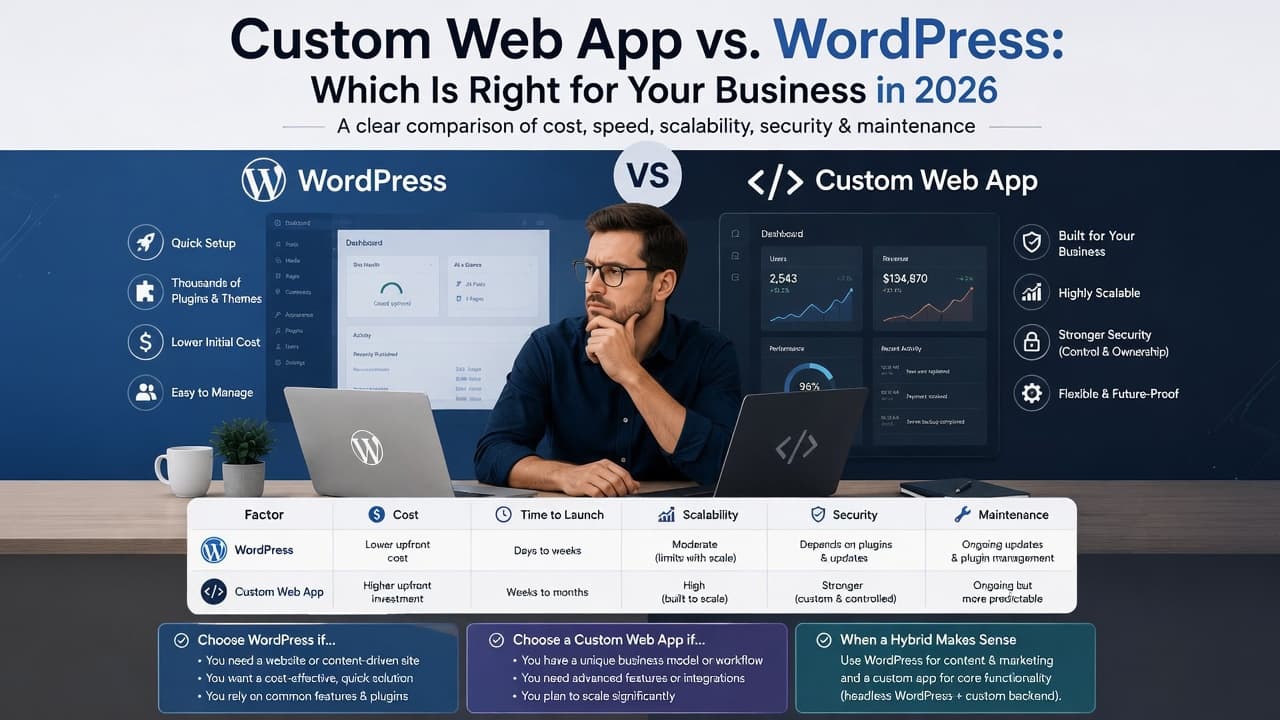
Custom Web App vs WordPress: Which Is Right for Your Business in 2026?
Sooner or later, almost every business planning a new website or product runs into the same debate: WordPress, or a custom-built web app?
It's a fair question, and it gets asked constantly for good reason; the two options solve genuinely different problems. A local business that just needs a professional-looking marketing site has almost nothing in common, technically, with a company trying to build a customer portal or a SaaS product from scratch. Treating them as the same decision is where most of the confusion comes from.
So instead of picking a winner, let's actually walk through what each option is good at, where each one starts to strain, and how to figure out which side of the line your business falls on.
What You're Actually Choosing Between
WordPress
WordPress is a content management system, and it still powers a huge share of the web, somewhere north of 40% of all websites, depending on which report you check. It's built to make publishing and managing content simple, and it does that well.
It's a strong fit for:
Business and marketing websites
Blogs and content hubs
Portfolio sites
Landing pages
Small online stores
Any site where content, not custom functionality, is the main job
With thousands of themes and plugins available, you can get a polished, professional site live without writing much code at all.
Custom Web App
A custom web application is software built around how your business actually works, rather than software your business has to adapt itself to fit. Every feature exists because you need it, not because it came bundled with a plugin.
This is the right category for things like:
SaaS products
Customer or client portals
Booking and scheduling systems
Inventory or operations management
Internal dashboards
Marketplace platforms
Healthcare, education, or finance portals with specific compliance needs
Modern frameworks like Next.js, React, Laravel, and Node.js make it possible to build these faster than it used to take, but it's still a fundamentally different kind of project than a WordPress site.
Quick Comparison
Factor | WordPress | Custom Web App |
|---|---|---|
Initial cost | Lower | Higher |
Time to launch | Days to a few weeks | Several weeks to a few months |
Scalability | Good for most content sites | Built for growth and complexity |
Security | Depends heavily on plugins/themes | Stronger with proper architecture |
Flexibility | Limited by available plugins | Essentially unlimited |
Maintenance | Frequent plugin/theme updates | Predictable, developer-controlled |
Best for | Content-driven websites | Platforms, portals, and complex workflows |
Cost: Where WordPress Has the Clear Edge
For a lot of businesses, this is the deciding factor before anything else gets discussed.
WordPress keeps upfront costs low because most of the functionality already exists; you're customizing, not building from nothing. Typical costs are domain and hosting, a premium theme, a handful of paid plugins, and some light customization. For startups and small businesses working with a limited budget, that combination is hard to beat.
Custom web apps cost more upfront because you're paying for actual design and engineering work, UI/UX design, backend and frontend development, database architecture, testing, and ongoing refinement. What you get in return is software built specifically around your business rather than your business bending to fit a template.
On cost alone, WordPress wins. But cost alone rarely tells the whole story, which is why it's worth reading the rest of this before deciding based on price.
Speed: How Fast Can You Actually Launch?
If you need something live this month, WordPress is almost always the faster path. A business website can realistically go from nothing to launched in a matter of days to a few weeks.
A custom application takes longer because it involves real discovery, planning, design, development, and testing before deployment, usually somewhere between several weeks and a few months, depending on how complex the product actually is.
WordPress wins on speed, no real debate there.
Scalability: What Happens When You Grow
This is where the comparison starts to shift. A site handling a few hundred visitors a month behaves very differently from one supporting fifty thousand active users, and WordPress can start to strain as plugin count and custom functionality pile up over time.
Custom applications are built with growth already in mind. Adding new features, integrating additional APIs, handling larger databases, and supporting significantly more users doesn't usually require rebuilding the system from the ground up; it's part of the architecture from day one.
Custom web apps win on scalability, particularly for anything expected to grow meaningfully over the next few years.
Security: Fewer Moving Parts, Fewer Risks
WordPress itself is reasonably secure. The risk usually comes from the ecosystem around it; most WordPress sites lean on a stack of third-party plugins, and if even one of them falls out of date, it becomes a potential entry point.
Custom applications don't eliminate security risk, but they do reduce it by cutting down on unnecessary third-party code. Because the features are built specifically for the project, there's more direct control over authentication, permissions, and how data is stored and handled.
Custom web apps generally win on security, mostly because there's simply less surface area to defend.
Maintenance: Predictable vs. Ongoing
Every website needs upkeep — the question is what kind.
WordPress maintenance usually means regularly updating the core software, plugins, themes, and backups, and occasionally troubleshooting when two plugins quietly conflict with each other after an update. It's manageable, but it's an ongoing task that doesn't really stop.
Custom application maintenance tends to be more predictable, since your development team controls the entire codebase rather than juggling dozens of third-party dependencies. You're improving one system built for your business, not coordinating updates across a patchwork of plugins.
Choose WordPress If...
You need a company or marketing website
Content is the primary goal, not custom functionality
You want to launch quickly
Your budget is limited
Your workflows aren't particularly complex
Existing plugins can realistically cover what you need
For a large share of small businesses, WordPress genuinely is the right call, not a compromise, the right call.
Choose a Custom Web App If...
Your business runs on workflows that don't fit a standard template
You need customer dashboards, portals, or account systems
You're building a SaaS product
You need complex user roles or permissions
Your platform needs to integrate deeply with other systems
Long-term performance and scalability actually matter to the business
Custom software costs more to start, but it gives you full ownership over how the platform behaves, no working around a plugin's limitations, no waiting on a theme update to fix something.
The Hybrid Approach More Businesses Are Landing On
Increasingly, growing companies aren't choosing one over the other; they're running both, deliberately.
A common setup looks like this: WordPress handles the marketing site, blog, and SEO content, while a custom web app runs the parts of the business that actually need custom logic, customer dashboards, booking systems, internal tools, whatever the operational core requires.
This gives the marketing team a platform that's easy to manage without needing a developer for every content change, while the actual product or operations run on software built specifically to handle them. It's become a genuinely popular architecture in 2026 for exactly that reason; it doesn't force a single tool to do two very different jobs.
Which Option Actually Delivers Better ROI?
This is worth sitting with for a second, because upfront cost and long-term value aren't the same thing. A cheap website that quietly caps your growth can end up costing more over a few years than the custom build would have. On the flip side, investing in custom software before your business genuinely needs it can just delay the point at which any of it pays for itself.
The right answer isn't about which technology is more impressive. It's about being honest about where your business is right now and where it's realistically headed over the next three to five years.
Frequently Asked Questions
Is WordPress still a good choice for businesses in 2026? Yes, particularly for marketing websites, blogs, and content-driven sites where speed and budget matter more than custom functionality. It remains one of the most reliable platforms for that specific job.
When should a business move from WordPress to a custom web app? Usually, when the business needs functionality that doesn't fit neatly into a plugin, customer portals, complex user permissions, deep integrations, or workflows unique to how the business operates. If you're stacking plugins to force WordPress into a role it wasn't built for, that's often the sign.
Can WordPress and a custom web app work together? Yes, and it's becoming increasingly common. Many businesses run WordPress for their marketing site and content, while a separate custom application handles the operational or product side of the business.
Is a custom web app more secure than WordPress? Generally, yes, mainly because custom applications rely on less third-party code. WordPress itself isn't inherently insecure, but the plugins many sites depend on can introduce vulnerabilities if they're not kept up to date.
Final Thoughts
There's no universal winner in the WordPress vs. custom web app debate, and honestly, anyone claiming there is probably hasn't built both. WordPress remains one of the best tools available for business websites, blogs, and content-driven projects. It's affordable, fast to launch, and straightforward to manage. Custom web applications offer flexibility, scalability, and control that WordPress simply isn't designed to provide once a business needs real product-level functionality.
The right decision isn't about picking the more powerful technology. It's about picking the technology that actually fits where your business is and where it's going.
Need Help Choosing the Right Foundation?
Whether you're planning a new website, building a SaaS platform, or replacing software that's outgrown your business, the platform you choose now shapes what's possible later. We work across custom software development, modern Next.js applications, and WordPress, so the recommendation you get is based on what your business actually needs, not which platform we'd rather build in.
Tell us what you're building, and we'll help you figure out whether that's WordPress, a custom web app, or a hybrid of both.